The Phantom’s Revenge Opens
The Phantom’s Revenge soft opened on Friday, May 18, 2001, and officially opened to the public the following day, Sunday, May 19.
The Phantom’s Revenge Experience
Riders got in line for the redesigned coaster beneath its 160-foot teal lift hill, stretched high above the relatively new Lost Kennywood section. A dark, hooded Phantom figure marked the entrance. The long elevated queue led to a decorative Phantom portal, which was the entrance to the station.
Trains
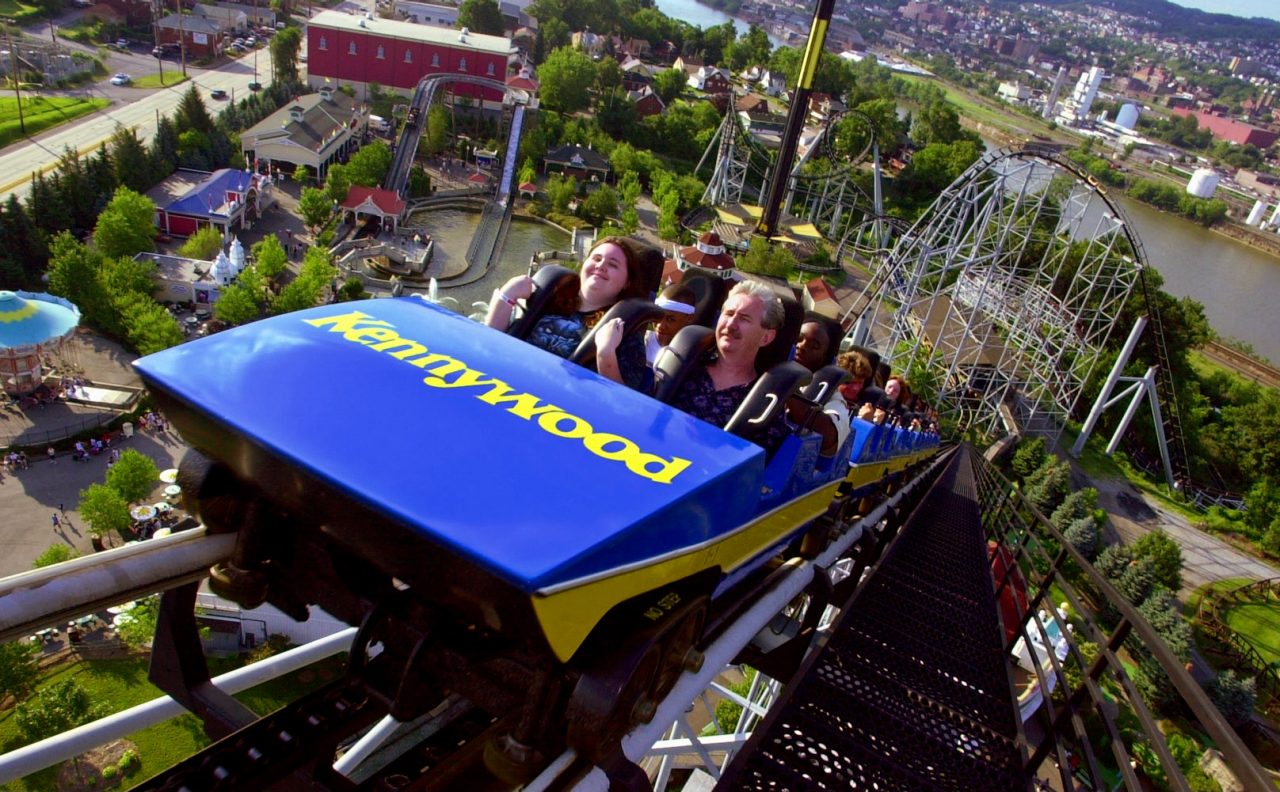
The trains were tailor-made for The Phantom’s Revenge; they were completely unlike those on other Morgan hypers, which made this coaster experience unique for several reasons. Morgan built the new trains using the repurposed Arrow chassis from Steel Phantom, modifying them with custom-fabricated bodies—almost like a stylish classic car—and newly designed harnesses.
Because the framework was originally built for over-the-shoulder restraints, traditional front-mounted lap bars were physically not an option; instead, Morgan’s solution was to install side-mounted lap bars, giving riders more space while still being safe and secure. Kennywood was proud the ride finally had comfortable restraints, even advertising “no shoulder harness” as a key feature.
The Phantom’s Revenge only had one train for its first season until the second was ready the following year.
The trains had seven cars, each seating four passengers for a total of 28 per cycle, giving the coaster a theoretical capacity of 1,400 riders per hour.
The Layout
Once riders pulled down their side-mounted lap bars, the train rolled into a layout familiar to anyone who rode Steel Phantom: a turn out of the station, up the lift, down a 157-foot banked drop, across some straight track, and up the second hill.
The rest of the layout from here was re-tracked and redesigned by Morgan.
The train coasted over the 110-foot hill and rolled into its once-record-breaking plunge down the ravine, which was slightly extended to 228 feet. Anyone with their hands up down the drop probably held on tight as the train narrowly zipped through Thunderbolt.
At this point, the upgraded Phantom’s Revenge raced to its new top speed of 85 mph, pulling into a widened 82-degree left-hand turn.
The layout banked to the other direction, passing through a tunnel under Thunderbolt, and curving around the historic Turtle tumble bug attraction. In place of the old inversions, The Phantom’s Revenge rushed into a cluster of tight turns, snappy dips, and powerful airtime hills, which a review in the Pittsburgh Post-Gazette compared to riding a bucking bronco.
After a rapidly paced second half, the coaster hit the brakes and returned to the station.
Reception
The newly renovated coaster was instantly beloved, being applauded for its intensity and, better yet, its smoothness. The coaster became noticeably more enjoyable with its rider-friendly bunny hills that took the place of the former inversions.
Most importantly, riders suddenly found The Phantom’s Revenge far more comfortable thanks to its widely praised lap bars that replaced the jarring over-the-shoulder restraints. The new lap bars securely gave riders more freedom without the pain of headbanging. As one American Coaster Enthusiasts member told the Pittsburgh Post-Gazette, “Now…you can enjoy the speed much more comfortably.”
Guests could painlessly ride The Phantom’s Revenge over and over, unlike the one-and-done tendency most had before the overhaul.
The old Steel Phantom was still highly ranked in its final years, being in the top 20 steel coasters in the Golden Ticket Awards; however, after The Phantom’s Revenge opened, it climbed as high as No. 5. Kennywood’s decision to transform Steel Phantom into The Phantom’s Revenge proved to be the right choice.
About the Author

You May Also Enjoy…
There’s More to Explore
Check out the video versions of these stories on YouTube.
This article was provided at no cost to you, so any support—even just a follow on social media—helps keep this project running.
Unlock more on the Storybook Amusement Patreon.
Enjoy the ride.
About These Articles
The articles on this website were researched and written by a theme park enthusiast as part of an in-depth YouTube series.
To ensure accuracy, each article is outlined and fact-checked from sources such as newspaper archives, interviews, books, and historical documents. Some sources are not available online but can be referenced upon request.
Content creators who reference information from this website are kindly asked to cite the original source or Storybook Amusement. Thank you.