Announcing The Phantom’s Revenge
In August 2000, Kennywood announced Steel Phantom would be converted into a new coaster experience known as The Phantom’s Revenge.
Watch on YouTube
This article is available in video form with added visuals. Click here to watch it.
[/fusion_text]
A Legend Gets Its Revenge
To promote the conversion, an outside marketing firm gave the Phantom its own persona and backstory.
According to the legend, the spirit of Steel Phantom learned about Kennywood’s plans to dismantle the coaster. Fans weren’t the only ones upset about this news—the Phantom was even more disturbed. Park officials were oblivious to the Phantom’s unrest and moved ahead with their plans to close the coaster.
The Phantom was not pleased.
All of a sudden, strange incidents started happening around Kennywood. The sky above Steel Phantom turned dark, even on sunny days. Its queue had a chill in the air, regardless of the weather. Gift shop shelves were mysteriously cleared, and nearby windows were found shattered.
Someone—or something—had it out for Kennywood. Who—or what—was behind it all?
The story took a strange turn when the blueprints for Kennywood’s new ride went missing. They vanished without a trace until turning up in an unlikely way: shredded and scattered all across the load platform of Steel Phantom. The employees tried to sweep it away, but the scraps of paper kept piling up. It was too much, forcing the ride to shut down.
Then, everyone covered their ears as an awful noise screamed through the ride’s loudspeakers. A deep, menacing voice made its presence known. “You dare vanquish the Steel Phantom without my consent,” the Phantom threatened. “Fear the wrath of the Phantom! Mortals did not create the Phantom legend and cannot sever my presence from Kennywood. Hear me and know: Only I can transform the Steel Phantom, or you will face my vengeance!”
Everyone looked as if they had seen a ghost, and—well—that’s because they had. Breaking the silence, a dark, cloudy figure floated into the station and whooshed to the infamous inversions. The shadowy cloud grew to the size of the coaster track, showing its green eyes and long hands that ripped apart each inversion.
Panicked employees shouted, “Not our ride!”
“Not your ride,” the Phantom insisted.
People watched in horror as the Phantom tore apart the coaster, leaving only the first drop and iconic dive into the ravine unharmed. The Phantom parted with these words: “You will do my bidding.” Then, spirit disappeared.
Despite the chaos and destruction, not a single piece of track was out of place. It was a confusing scene, but the vision was clear. Witnesses warned park management of the Phantom’s demands, and they honored the spirit by canceling their plans to replace the coaster—but rather restore it so the legend could live on.
The Actual Development of the Ride
While that was a creative way to announce the coaster’s redesign, the actual development was a bit different.
The Phantom’s Revenge would be a Franken-coaster, combining track sections by two different manufacturers. The goal was to create a smoother ride by embracing its best features—height and speed—and trading its knockout inversions for standout airtime.
“While the loops will be missed, the head-banging they required will not be.”
An excerpt from the Pittsburgh Post-Gazette, 2000
D. H. Morgan Manufacturing took on the project, salvaging the decade-old Arrow track and introducing a modified layout with new track. Considering Morgan’s history with Arrow, the new track style was adaptable to the classic tubular steel design. This time around, modern technology allowed for more advanced design and fabrication methods, resulting in a more sophisticated track profile.
“Kennywood has provided us with a very unique opportunity to create a totally new ride experience, while still retaining the Steel Phantom’s world-class second drop through the Thunderbolt structure. The new ride will be very fast, very smooth, and feature lots of airtime!”
Dana Morgan, founder of D. H. Morgan Manufacturing, UltimateRollerCoaster.com, 2000
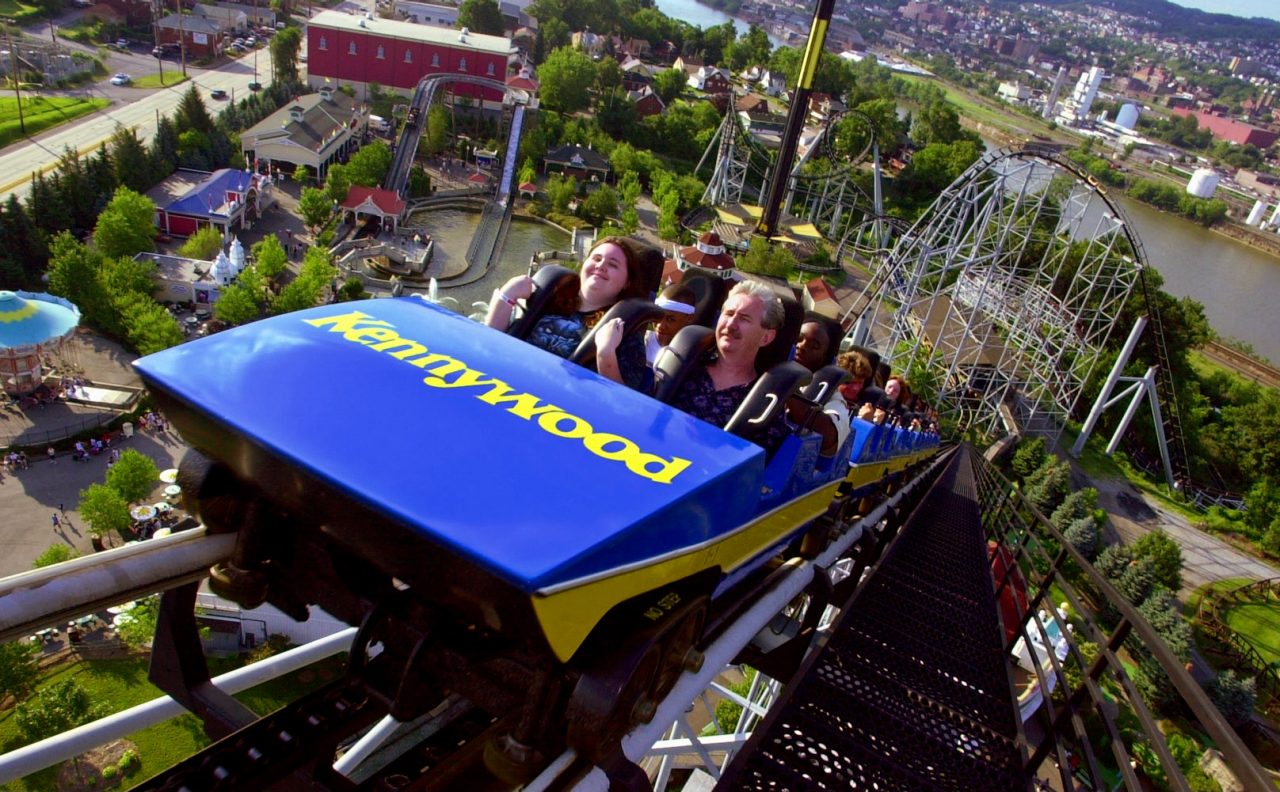
A little less than a third of that original Arrow track was being reused, including the station, pre-lift section, lift hill, first drop, second hill, and brake run. The remaining sections were completely redesigned and rebuilt by D. H. Morgan Manufacturing.
The legendary 225-foot drop, for example, was extended by a few feet, which would also increase the coaster’s top speed.
“Since announcing our plan to replace the Steel Phantom with a new coaster, coaster lovers from around the world have expressed dismay at the thought of losing what many believe to be the best, most exciting drop of any roller coaster on earth: the 225-[foot] plunge, which sends the Steel Phantom speeding through the Thunderbolt.”
Harry “Henny” Henninger, UltimateRollerCoaster.com, 2000
At one point in the planning phase, the second hill may have been redesigned as a double-up. The left-hand turn at the bottom of the Thunderbolt near-miss was re-tracked to be wider, reducing the abrupt discomfort of that element. Most notably, the former looping section was replaced with a collection of airtime hills and turns. Overall, the layout gained an additional 325 feet of track.
By removing the coaster’s inversions, the uncomfortable over-the-shoulder-style restraints could be replaced by lap bars, leading to a smoother ride experience.
About the Author

You May Also Enjoy…
There’s More to Explore
Check out the video versions of these stories on YouTube.
This article was provided at no cost to you, so any support—even just a follow on social media—helps keep this project running.
Unlock more on the Storybook Amusement Patreon.
Enjoy the ride.
About These Articles
The articles on this website were researched and written by a theme park enthusiast as part of an in-depth YouTube series.
To ensure accuracy, each article is outlined and fact-checked from sources such as newspaper archives, interviews, books, and historical documents. Some sources are not available online but can be referenced upon request.
Content creators who reference information from this website are kindly asked to cite the original source or Storybook Amusement. Thank you.