Reception
Upon opening, Steel Phantom was a success. For locals, having a record-breaking coaster in their small hometown park was a point of pride. Its use of the terrain, interaction with Thunderbolt, and unexpected inversions made Steel Phantom the type of coaster that could only exist at Kennywood.
In the words of a columnist from The Pittsburgh Press in 1991, “Not even Christmas as a kid could top having a great new coaster as close as West Mifflin.” He continued, “Anyone riding anything other than Steel Phantom from now on will be marking time or resting before getting back in line for the real ride.”
Those outside the media had high praise for the ride too; parkgoers and devoted coaster enthusiasts raved about Kennywood’s latest addition.
Some coaster enthusiasts shared their thoughts with The Pittsburgh Press, calling it “one of life’s great experiences. It’s for anyone who enjoys traveling at illegal speeds.” One enthusiast called it the “most intense coaster [they]’ve ever been on,” while another went as far as to say it “makes you find religion.” One more hinted at how a ride on Steel Phantom felt, describing, “It’s bang, bang, bang—one element after another.”
More than 2 million riders were brave enough to take on Steel Phantom in its first season, but not all of them were fans. In terms of intensity, the ride stood in a class of its own—for better or for worse.
“You don’t want to do that too often. That was incredible.”
Sheila Hyland, WTAE-TV Pittsburgh, 1991
Rough Reviews
Riders on Steel Phantom felt as helpless as a sausage in a rocket blastoff—oh, that was for Laser Loop. Never mind. But, whatever that meant, it probably was still an accurate description for Steel Phantom based on the ride’s reputation.
On paper, Steel Phantom was an excellent coaster. In reality, it had its flaws.
The most common complaint was about its roughness, a problem made worse by the over-the-shoulder restraints. While these restraints were standard on Arrow’s looping coaster model, Steel Phantom operated at higher speeds with more intensity than other installations.
The layout’s mix of quick transitions and relentless inversions often caused riders to bump their heads on the over-the-shoulder restraints. This wasn’t so much an issue in the first half, including the 225-foot drop, but the rest of the layout was often considered too uncomfortable.
Once the ride reached its fastest point, the course hurtled into a quick left turn. This element caused riders to hit their heads against the restraints while traveling no less than 80 mph. Another rough spot came during the upward section into the vertical loop; still having a lot of momentum from the drop, the train shuffled through that clumsy transition. Unsurprisingly, the four intense inversions only added to the discomfort for most riders.
To get a sense of which elements were excessively rough, notice how the point-of-view videos were relatively steady until certain elements shook the camera.
It was an “Advil-promoting” coaster, as described by the Pittsburgh Post-Gazette. Do you remember the newspaper writer who would rather be hit by a car than ride Steel Phantom? He called it a “sleek 3,000-foot medieval-like torture chamber.”
Even the coaster’s designer, Ron Toomer, admitted in a 1991 interview he’d “get sick as a dog” if he actually rode Steel Phantom—though, despite his career, he was ironically prone to motion sickness.
The Issues of Steel Phantom
Not all the criticisms of Steel Phantom were tongue-in-cheek. Some riders made serious complaints that the rough ride caused neck pain. These issues only escalated.
A few ride-related incidents occurred during Steel Phantom’s opening weekend.
The first report involved a mother and a daughter who claimed to have been injured after being “thrown about excessively and repeatedly” on the coaster. Another rider described being “thrown and jolted with excessive force,” alleging the coaster was “defective” and “unreasonably dangerous.” These complaints resulted in a lawsuit in the Court of Common Pleas against Kennywood and the manufacturer.
Occasional ride-related lawsuits were not unusual for an amusement park like Kennywood, which usually faced about two per year. As with all incidents, these claims were taken seriously, especially given the rough condition of this brand-new attraction.
In response to the criticism, Kennywood shut down Steel Phantom just after its opening weekend.
During the closure, an investigation revealed the coaster exceeded its advertised top speed of 80 mph, racing up to 83 mph. Though a 3-mph difference may not seem like much, this was much faster than anticipated. The higher speed directly affected the ride experience by making it more intense, especially the abrupt turns and inversions.
Going back to previews in early May, the coaster was clocked going only 78.2 mph but was expected to top out at just 80 mph when warmed up. Roller coasters can pull off different speeds depending on factors like temperature and the weight of the train, based on the weather and number of riders.
As an attempt to improve the rough ride experience, Kennywood and Arrow made a permanent modification to Steel Phantom. Trim brakes were added on the upward slope into the first inversion, the vertical loop. This modification slowed the train before the twisted half of the layout; although, the trim brakes were placed after the coaster’s fastest moment, still allowing it to exceed its advertised top speed. Overall, this change made the forces more manageable.
Ann Hughes, a park spokesperson, reassured the press by mentioning an adjustment to a brand-new ride was normal practice, especially for one this ambitious.
After its modification, Steel Phantom reopened a week and a half later on May 23, 1991.
Steel Phantom Hurtles On
The trim brake alleviated some of the intensity and high-speed transitions, but Steel Phantom still wasn’t perfect. Like any ride, Steel Phantom had its fans, especially coaster enthusiasts, but its rough reputation among the general public was spreading.
Arrow looping coasters, even in their prime, were notorious for being rough. They were designed and engineered without the advantage of modern methods. As coaster designs of that era became more intense, their limitations became more obvious; their old-fashioned flaws were too much to ignore.
Drachen Fire at Busch Gardens Williamsburg, another Arrow looping coaster from this era, was a prime example of the manufacturer’s shortcomings; it opened a year after Steel Phantom but shut down by the late ‘90s because of its painful layout.
Steel Phantom, in particular, was unlike other coasters, combining hypercoaster and mega-looper elements. Its unusual, intense layout was engineered in an old-school way and was even ricketier with its over-the-shoulder restraints.
To convince anyone who may doubt how rough Steel Phantom was, consider this: To avoid injury, riders were instructed to remove any earrings before getting on. That rule said everything anyone needed to know. Steel Phantom was concerningly rough; that was no secret.
When the park first planned the attraction that would become Steel Phantom, it was meant to replace a challenging coaster that was a headache to maintain. However, Kennywood ultimately traded one headache for another.
Building Steel Phantom was a risk-reward decision. Kennywood reaped the rewards with record-breaking achievements, but the risks were becoming a real issue.
Records Bumped
Regardless of its criticisms, Steel Phantom was still a record-breaking coaster, but not for long. By its fourth season in 1994, Steel Phantom had to share its claim to fame of being the fastest coaster and having the longest drop when another Arrow hypercoaster, Desperado, opened at Buffalo Bill’s Hotel and Casino. The drop record was officially bumped in 1996 by Fujiyama, a Japanese hypercoaster by TOGO, which unofficially broke the speed title as well.
Steel Phantom lost its records.
The coaster industry passed it by in just half a decade. Before long, rides like Superman: Escape from Krypton at Six Flags Magic Mountain shattered the structural height record, surpassing 400 feet; parks like Cedar Point and Nagashima Spa Land were on track to surpass the 300-foot barrier by the new millennium, which was unheard of for a continuous-circuit coaster.
Kennywood—lacking the space and budget—had no way to match or beat the astronomical coaster records being set at the time. The novelty of Steel Phantom was slipping away, and the hometown park was struggling to pull in crowds beyond its local base.
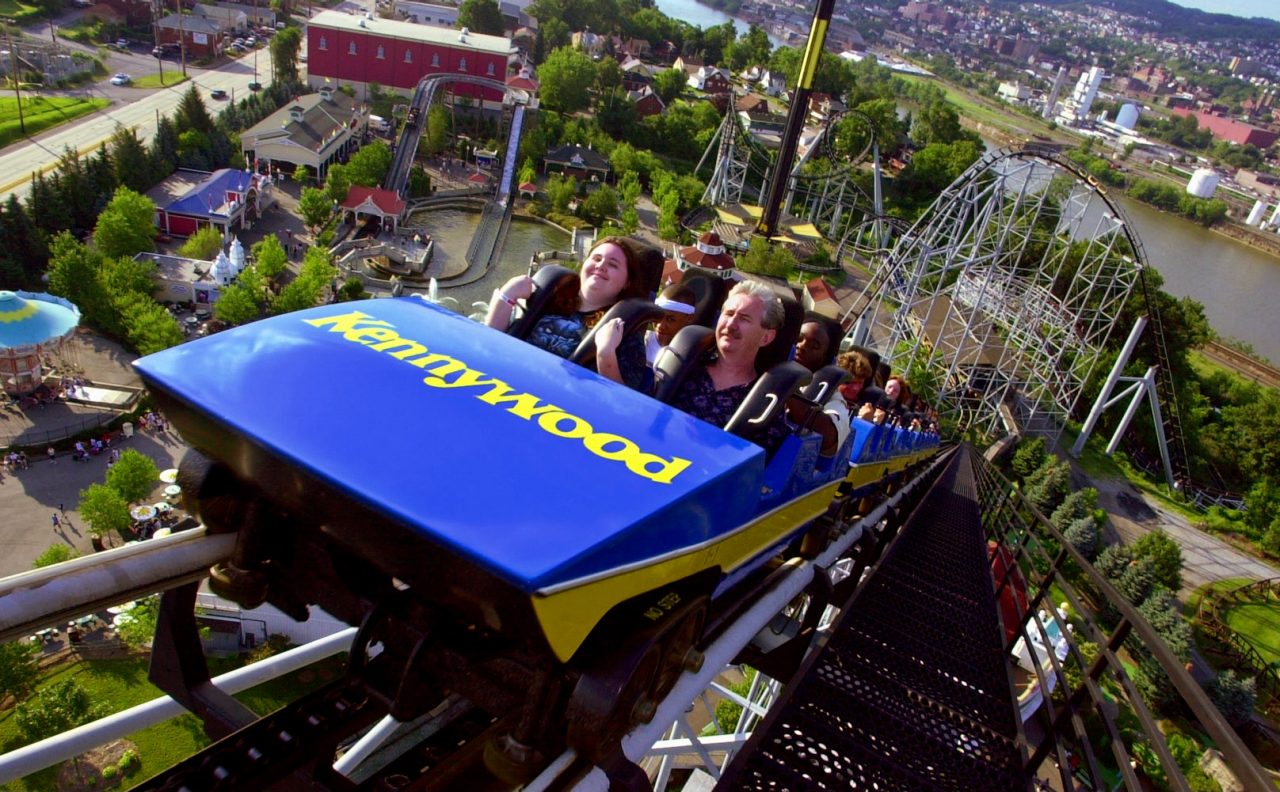
The park, as expected, still took good care of Steel Phantom. The coaster added a second train in its sophomore season, bringing its capacity to 1,100 riders per hour. By the mid-‘90s, the two trains were updated with a blue finish and yellow trim.
Regardless of the maintenance, ridership for Steel Phantom declined as the years went on. Its roughness was well known by then, and most riders found it too intense to enjoy, especially on repeat rides. Though it kept a loyal following, the coaster lacked wide appeal, took up a lot of square footage, and was no longer making an impact at the gate.
Kennywood needed to make a change, and Steel Phantom’s future was in jeopardy.
About the Author

You May Also Enjoy…
There’s More to Explore
Check out the video versions of these stories on YouTube.
This article was provided at no cost to you, so any support—even just a follow on social media—helps keep this project running.
Unlock more on the Storybook Amusement Patreon.
Enjoy the ride.
About These Articles
The articles on this website were researched and written by a theme park enthusiast as part of an in-depth YouTube series.
To ensure accuracy, each article is outlined and fact-checked from sources such as newspaper archives, interviews, books, and historical documents. Some sources are not available online but can be referenced upon request.
Content creators who reference information from this website are kindly asked to cite the original source or Storybook Amusement. Thank you.