A Race to the Top
And the Arrow That Shot the Amusement Industry to the Top
As with many amusement park stories, the 1955 opening of Disneyland Park in Anaheim, California, deserves to be mentioned. A great deal of Disneyland’s opening-day and early attractions were manufactured by a company called Arrow Development.
Arrow opened its doors a decade earlier, staying afloat by taking on equipment-related jobs. Their work eventually shifted to manufacturing kiddie rides and later connecting with Walt Disney himself. The Arrow-Disney partnership led to major breakthroughs in the amusement industry, including the development of the first modern tubular steel-track roller coaster, Matterhorn Bobsleds.
Arrow, following its partnership with Disney, moved forward under designer Ron Toomer and Dana Morgan, son of co-founder Ed Morgan.
The company threw the industry for a loop in 1975, engineering the prototype for the first modern roller coaster with inversions. Arrow’s latest innovation, Corkscrew at Knott’s Berry Farm in California, was just the beginning for inverting roller coasters.
The Corkscrew model was a breakout hit in the mid-‘70s, appearing in amusement parks across the U.S. and Asia by the end of the decade. Building on that momentum, Arrow evolved the design and pushed the limits of height, speed, and intensity.
Arrow’s Mega-Loopers
By the mid- to late-‘80s, Arrow, which became Arrow Dynamics, manufactured a line of custom mega-loopers that rose above the rest of the industry.
Vortex at Ohio’s Kings Island turned riders upside-down a whopping six times—a record in 1987. That was surpassed the following year by Shockwave at Chicago’s Six Flags Great America, climbing 170 feet high with seven inversions. Arrow hit seven inversions once again in 1989 with The Great American Scream Machine at New Jersey’s Six Flags Great Adventure.
At California’s Six Flags Magic Mountain, Arrow outdid itself once again with Viper. This seven-inversion mega-looper had staggering stats for its time—standing 188 feet tall and clocking in at 70 mph.
Back at Kennywood, park officials were well aware of Arrow’s accomplishments with mega-loopers. The park’s general manager, Harry Henninger, took firsthand notice of Viper and its impressive banked first drop.
Yet, Arrow’s engineering capabilities magnified beyond the heights of Viper.
Arrow Surpasses 200 Feet
In 1989, Arrow took coaster engineering to the next level with its latest installment, Magnum XL-200 at Cedar Point in Ohio.
It was originally designed to be 187 feet tall, but Cedar Point requested to break the 200 foot barrier for a more marketable investment. Promoted as the first hypercoaster, this 205-foot giant dominated the Lake Erie shoreline with its record-breaking height and speed for a continuous-circuit coaster.
“In 1989, 200 feet might as well have been somewhere to the moon. It was incredible.”
Anne Irvine-Ondrey, CEO of Irvine Ondrey Engineering, 2017
The opening of Magnum XL-200 has been considered the start of the coaster wars, a period in which amusement parks competed year after year to open the next record-breaking thrill ride.
“I think there’s no limit now. I think the only limit we’re going to see is what people will get on.”
Ron Toomer, president of Arrow Dynamics, America’s Greatest Roller Coaster Thrills in 3D, 1994
Kennywood Dreams of New Heights
Kennywood, although a much smaller park than the likes of Cedar Point, was eager to modernize its ride lineup and enter the race. Park officials noticed what Cedar Point achieved with its attention-grabbing hypercoaster and wondered what a ride like that could do for their local park. A record-breaking ride in the place of Laser Loop would be great for marketing.
Realistically, though, building a record-breaker was a pipe dream for Kennywood. The hometown park could not build a traditional hypercoaster for a few practical reasons. Big coasters required big commitments.
For one, the only way a coaster could achieve record-breaking heights was with a large, land-consuming lift. A traditional lift hill climbing about 200 feet would logistically take up a long, continuous stretch of land. The landlocked Kennywood could not dedicate space for a towering lift hill, let alone a massive out-and-back layout like Magnum.
The cost was another issue. Kennywood entertained just over 1 million visitors annually at that time, according to the park’s manager in a 1990 Pittsburgh Press interview. Those attendance numbers, while fine for a park of that size, simply could not generate the revenue needed to outdo larger amusements in the region.
“It’s going to cost $4 million to $4.5 million, which we cannot justify for a park that entertains about 1.2 million per season.”
Harry “Henny” Henninger, The Pittsburgh Press, 1990
Also, tall roller coaster elements required a lot of material for supports to raise the track hundreds of feet in the air. Reaching those heights came at a steep price. The family-owned park had a more limited budget and could not possibly afford the materials needed to construct a record-breaking hypercoaster.
Kennywood was at a disadvantage, and a hypercoaster was unlikely. The park, however, did have one uncommon advantage: terrain.
The Upside of Kennywood’s Downside
Kennywood was situated along a ravine with steep slopes down to the Monongahela River. The hilly property, however, has not kept the park from building new rides. In fact, some of Kennywood’s longtime coasters made use of the area’s natural landscape; the dips and drops of the historic Jack Rabbit and Thunderbolt wooden roller coasters have hugged the area’s hillsides since the 1920s. Because of the terrain, both these coasters have drops right out of the station with their lift hills partway through the course.
“We’re able to do some pretty dramatic rides because of the topography.”
Mary Lou Rosemeyer, park spokesperson, 2000
Harry Henninger, or “Henny” for short, realized this advantage when dreaming of a record-breaking coaster. Henny, a third-generation employee at Kennywood, had the idea to use the ravine to break roller coaster records. The steep drop-off could theoretically be used for large, low-to-the-ground coaster elements without the need for tall structures. So, Henny drafted layout concepts that made use of the terrain.
Suddenly, Kennywood’s goal of a record-breaking coaster felt within reach. Laser Loop’s replacement could be on a scale never imagined possible, being a custom steel mega-coaster.
The next step was to find the right manufacturer for such a tall order.
Arrow Dynamics Breaks Records at Kennywood
Following the maintenance issues of Laser Loop, Kennywood chose not to partner again with the shuttle coaster’s manufacturer nor its distributor—Schwarzkopf and Intamin, respectively. Park officials ordered proposals from a few companies, but one stood out for its track record of successful mega-coasters: Arrow Dynamics. Henny’s concept combined a few of Arrow’s innovations—such as Viper’s drop, Magnum’s height, and a mega-looper’s intense inversions—into one thrill ride. Arrow had proven to be the clear choice for the job.
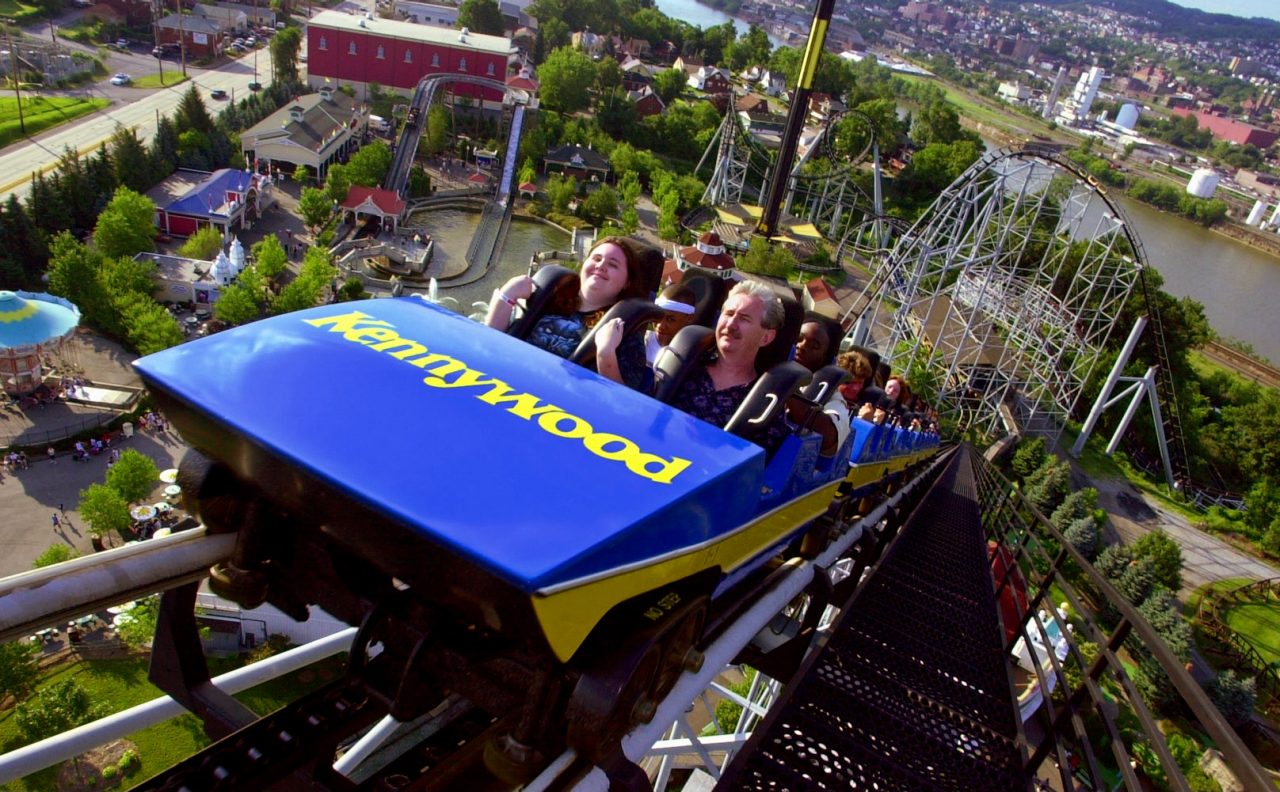
The Utah-based manufacturer calculated and engineered Henny’s layout concepts under the direction of designer Ron Toomer. The design followed a style similar to Arrow’s other coasters, featuring a moderately tall lift hill and a quadruple-looping finale; what set this one apart, however, was a creative use of the park’s steep ravine, resulting in the world’s longest drop. That massive drop would also make it the fastest coaster in the world.
Kennywood: home of the world’s fastest coaster with the longest drop. They could get used to the sound of that.
It was a custom design with a unique mix of elements—just what Kennywood needed to draw attention, but at what cost?
A project like this—Magnum XL-200, for example—could easily cost around $8 million, which was well out of the small park’s budget. However, the terrain-hugging design of Kennywood’s coaster kept costs to a more reasonable $4.5 million.
The stats, price, and excitement matched exactly what the park was looking for. The project was greenlit, and Kennywood would never be the same again.
Developing “The Big One”
Construction began as soon as the former Laser Loop was disassembled, with its original station being relocated and repurposed for the new coaster. “Engineering changes” delayed some prep work on the site, but the job was on track soon after. Sections of Arrow’s signature tubular track arrived at Kennywood by summer 1990.
In the meantime, Kennywood held an employee poll to name the new coaster, which was tentatively called “The Big One.” Possible names included “Nightmare,” “Lightning Express,” “Excess Express,” and “Steel Phantom.” “Steel Phantom” was the clear winner, receiving three times as many votes as the next closest contender. The name, which was officially announced in July 1990, matched the magnitude of the ride Kennywood was building.
Construction for Steel Phantom continued through the off-season, though having twists and turns of its own. Park president Carl Hughes was optimistic the coaster could be ready by opening day, but the weather was not cooperative.
Rain and wind delayed the job, costing several workdays. The weather pushed back the coaster’s debut by about a month, but the crew made up for lost time by working 10-hour days, six days per week. As the project neared completion, some crew members worked nearly around the clock to catch up.
The hard work paid off as the coaster was ready to open by May 4, 1991—just weeks after the original target date. In early May, brave media members and employees were the first to take on Pennsylvania’s newest and largest coaster. Half-joking, a reporter from the Pittsburgh Post-Gazette admitted he wondered whether he could “avoid the assignment by getting hit by a car.”
Needless to say, Steel Phantom was intimidating—unlike anything built before—and the general public was ready to strap in.
About the Author

You May Also Enjoy…

There’s More to Explore
Check out the video versions of these stories on YouTube.
This article was provided at no cost to you, so any support—even just a follow on social media—helps keep this project running.
Unlock more on the Storybook Amusement Patreon.
Enjoy the ride.
About These Articles
The articles on this website were researched and written by a theme park enthusiast as part of an in-depth YouTube series.
To ensure accuracy, each article is outlined and fact-checked from sources such as newspaper archives, interviews, books, and historical documents. Some sources are not available online but can be referenced upon request.
Content creators who reference information from this website are kindly asked to cite the original source or Storybook Amusement. Thank you.