Creating Dueling Dragons
Regardless, Universal Creative workshopped the twin inverted roller coasters under the name Merlin’s Duelling Dragons, using British English spelling, but later simplified it to Dueling Dragons with a single L.
Dueling Dragons was going to be more than a thrill ride; it was going to be a never-before-attempted themed engineering project, standing out not only in Universal Orlando’s second gate, but across the entire theme park industry. Islands of Adventure’s vice president of design and creative development, Mark Woodbury, was enthusiastic, saying, “We set out to re-define the roller coaster experience.”
Thematically, the queue of Dueling Dragons was set to take place in the battered castle of Merlinwood forest, which had been overtaken by two fierce dragons: Fire and Ice. In the castle’s early concepts, guests waiting in line would have seen treasure, fighting dragon shadow effects, as well as Fire and Ice features made possible by water projection effects. These scenes were cut for budget reasons, but the attraction overall was progressing as a creative and engineering work of art.
“These aren’t just rides; these are stories we’re telling.”
Mark Woodbury, Winston-Salem Journal, 1999
Turning Islands of Adventure Upside Down
Developing dual suspended coasters was going to be a challenge, but the process would be worth it.
The concept of a suspended roller coaster had been tried before, but without lasting success.
In the late ‘70s, the long-standing Arrow Development engineered a prototype roller coaster with swinging carriages mounted beneath the track. The original concept included inversions, but those proved to be unworkable and were removed. The design became the basis for the first permanent modern suspended coaster. Its initial installation in 1981, The Bat at Ohio’s Kings Island, operated for only a few problematic seasons before its removal due to engineering shortcomings.
The coaster model was not yet feasible at that point, but by the ‘90s, an emerging coaster manufacturer flipped the industry upside down.
Universal commissioned the up-and-coming Bolliger and Mabillard to manufacture its dual inverted roller coasters. B&M’s state-of-the-art manufacturing produced smooth-yet-intense roller coasters, which were quickly in high demand across the theme park industry. The Swiss firm’s production schedule was booked out years in advance, so Universal secured a spot even before sorting out the ride details; all Universal knew for sure was they wanted B&M roller coasters at the second gate.
Despite having a young portfolio, B&M had produced a number of innovative designs—particularly its inverted model. In 1992, a first-of-its-kind B&M inverted coaster, Batman: The Ride, debuted at Chicago’s Six Flags Great America.
Double the Thrills
Universal Orlando would soon debut its own pair of B&M inverted coasters with double the thrills. Two world-class B&M inverts would be intertwined for one intense experience.
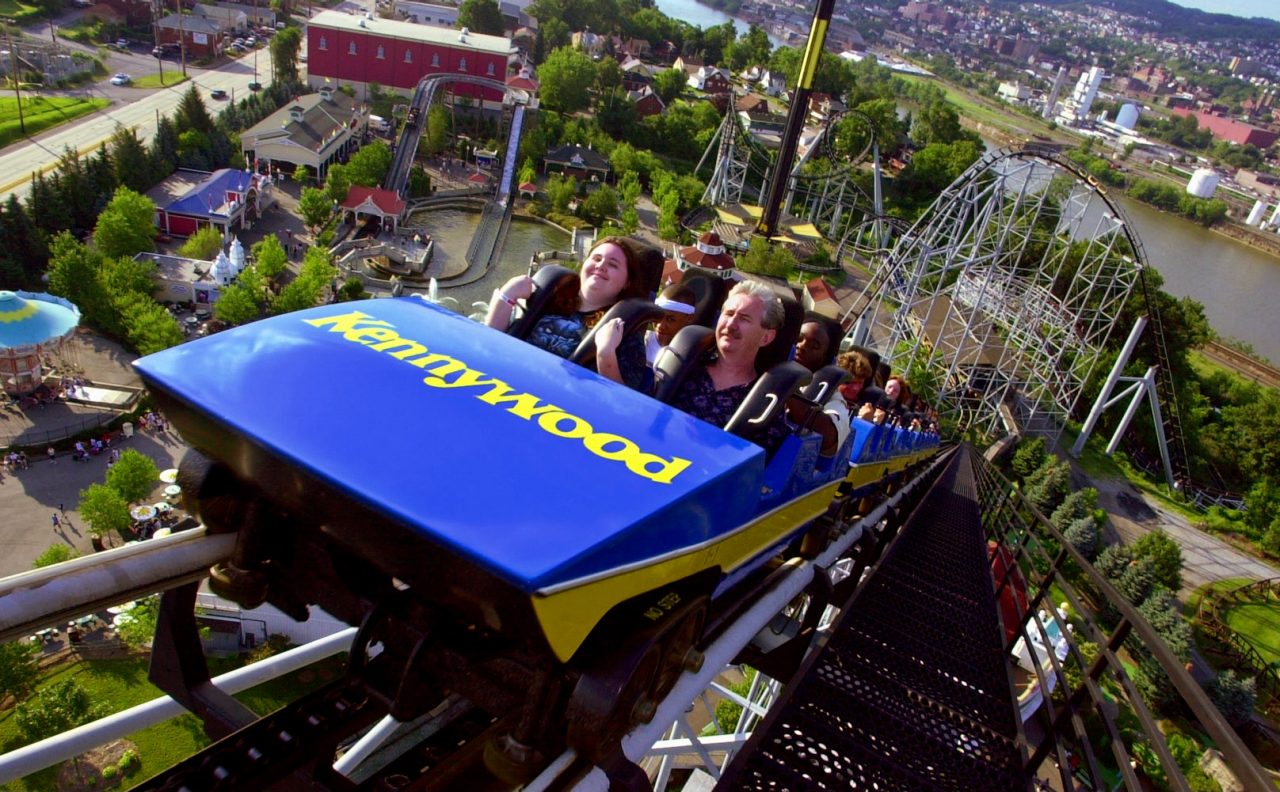
The idea of twin roller coasters had been around for a while, with classics like Kennywood’s Racer leading the way, but Universal’s Creatives had a new vision for the gimmick. Unlike past racing roller coasters with matching tracks, these dueling coasters would innovate with two opposing interlacing layouts—along the lines of Six Flags Great Adventure’s new Batman & Robin: The Chiller.
Between the engineering prowess of B&M and the creative backing of Universal, the $20-million Dueling Dragons was going to have two differing tracks with three thrilling near-miss elements.
“…We had this idea for a coaster unlike any coaster around. And the thought was to combine two state-of-the-art coasters. And unlike, you know, conventional wisdom would say, you know, avoid all objects, we intentionally set these two things out on a collision course to create near misses at really incredible, incredibly high speeds.”
Mark Woodbury, VP of Design and Creative Development, 2000
The designers of Dueling Dragons took advantage of the open B&M inverted train design, which riders’ legs dangled freely below the seats. The distance between the coasters’ near-miss elements were minimized while still having a safe reach envelope, bringing the feet of riders as close as a foot and a half apart; theoretically, if the two tallest possible riders sat in opposite trains, their shoes could be as little as 18 inches from each other at certain moments.
The unique track layouts were carefully engineered so the trains approached each near-miss element simultaneously. The precise timing was not a work of wizardry from Merlin himself, but the result of a system that weighed both trains to calculate the expected momentum as to adjust their individual lift hill speed and release, which optimized the synchronization through the near-miss elements.
The near-miss concept even worried some of the ride’s engineers during maiden test rides; a few nervously doubted the near-miss elements, but of course it was as thrilling and safe as designed.
“He was sure he had miscalculated…but of course it was fine. We all got a laugh out of that.”
Cathy Nichols, chairwoman and CEO of Universal Studios Recreation Group, Associated Press, 1999
Those close-call moments were key selling points for Dueling Dragons, especially for thrill seekers, but its theming was just as intense as the coaster.
Creative Touches
Dueling Dragons was becoming the flagship attraction of The Lost Continent and, as such, needed an impressive entrance area to make a striking first impression.
Universal partnered with Adirondack Scenic to create a dramatic pair of dragon sculptures. The team drafted the statues as maquettes and digitized those designs to engineer the steel frames—fabricated to withstand 120 mph winds against Florida’s seasonal hurricane conditions. Craftspeople added carved spray foam to the structures, then coating it with cement. The sculptures were painted and aged in icy cobalt and fiery carnelian colors, like mineral formations.
The base coaster trains were B&M’s standard design, but to add some dragon theming, Universal hired Kern Studios, a firm best known for producing Mardi Gras floats. The dragon designs were sculpted out of fiberglass with fierce eyes, scales, and claws to disguise the coaster trains as beasts.
To go along with the dragon-themed trains, the tracks were designed to mimic the sensation of flying. To accomplish this, the track pieces were filled with pea gravel, which dampened the typical roar of a roller coaster to sound like gliding through the air.
Construction on Dueling Dragons was moving along as the park’s opening day neared. Dueling Dragons was prominently featured in the Islands of Adventure Preview Center and other promotional material. It was a highly anticipated attraction at the brand-new park and didn’t disappoint during sneak previews.
However, during the coasters’ testing and preview periods, nearby residents complained about the attraction’s disruptive noise level. In response, Universal constructed a 55-foot-tall sound barrier wall in April 1999 around the perimeter edge of the twin coasters.
Guests could soon live the adventure at Universal Orlando’s newest park and duel with dragons in The Lost Continent.
About the Author

You May Also Enjoy…
There’s More to Explore
Check out the video versions of these stories on YouTube.
This article was provided at no cost to you, so any support—even just a follow on social media—helps keep this project running.
Unlock more on the Storybook Amusement Patreon.
Enjoy the ride.
About These Articles
The articles on this website were researched and written by a theme park enthusiast as part of an in-depth YouTube series.
To ensure accuracy, each article is outlined and fact-checked from sources such as newspaper archives, interviews, books, and historical documents. Some sources are not available online but can be referenced upon request.
Content creators who reference information from this website are kindly asked to cite the original source or Storybook Amusement. Thank you.